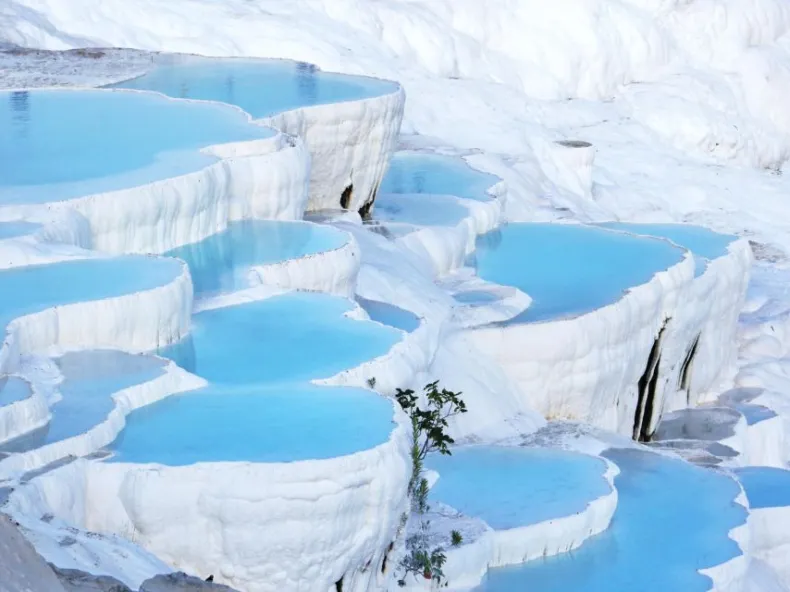
Seen from the plain below, Pamukkale looks like a hillside under snow that never melts. The Turkish name means cotton castle, and the white is neither snow nor cotton but calcite: for millennia, warm spring water saturated with dissolved limestone has spilled over this slope, shedding its mineral load as it cools and building terrace upon terrace of hard, bright travertine. Together with the ruined spa city of Hierapolis above, the terraces form a single UNESCO World Heritage Site — a rare mixed property, inscribed in 1988.
Visiting them is refreshingly simple. At the designated open section you take your shoes off — a site rule that protects the calcite — and wade through shallow, warm pools with the Denizli plain spread out below. We visit the terraces with a licensed guide on the full-day Pamukkale tour from the Antalya coast: €50 per person with three meals included, entrance tickets excluded and paid at the official gates.
How Thermal Water Builds a White Hillside
The springs that feed Pamukkale rise warm from deep underground, carrying an unusually heavy load of dissolved calcium carbonate. As the water runs over the edge of the plateau and begins to cool, it can no longer hold that mineral in solution, so it leaves a fine film of calcite on everything it touches. Repeat that for thousands of years and the film becomes stone: travertine, laid down layer after layer, hardening into the scalloped white basins the site is famous for.
The terraces are not a finished monument but a living process — the same water still flows and still deposits calcite, and the site administration channels it across different sections in turn so the whiteness keeps renewing itself. Fresh calcite is brilliantly white; that is the whole secret of the colour.
Barefoot in the Pools: Wading, Not Swimming
Shoes come off at the entrance to the open section — not as a ritual but as conservation. Soles grind dirt into the soft young calcite and stain it grey, so walking barefoot is the site rule that keeps the terraces white for the next visitor. The surface underfoot alternates between smooth stone, ridged calcite and warm flowing water, and the pools themselves are shallow: this is a place for wading and paddling, not swimming.
If you want to actually swim in thermal water, that pleasure lives a few minutes uphill in the Cleopatra Antique Pool, where you float above submerged Roman columns with a separate ticket bought on site.
Light, Photography and the White Surface
Calcite reflects almost everything the sun throws at it. In the middle of the day that makes the terraces dazzling — bring sunglasses — while morning and late afternoon give softer, warmer light, longer shadows in the ridged stone and far kinder photographs. Late light also turns the wet terraces faintly gold and pink as the sun drops toward the plain.
A practical note: you will be holding your shoes in one hand for much of the walk, so a small bag makes photography easier, and a towel is worth carrying if you plan to sit in the pools.
Seeing the Terraces on the Full-Day Tour
The terraces are the heart of our full-day Pamukkale tour from Antalya and the whole coast between Tekirova and Gazipaşa: hotel pickup, a licensed guide through the site, travel insurance and three meals for a flat €50 per person. Entrance tickets are deliberately excluded — gate prices are set by the site administration and change seasonally, so you pay the real official tariff at the ticket office; here is how the tickets work. Reserve online for free and pay on the day of the tour.