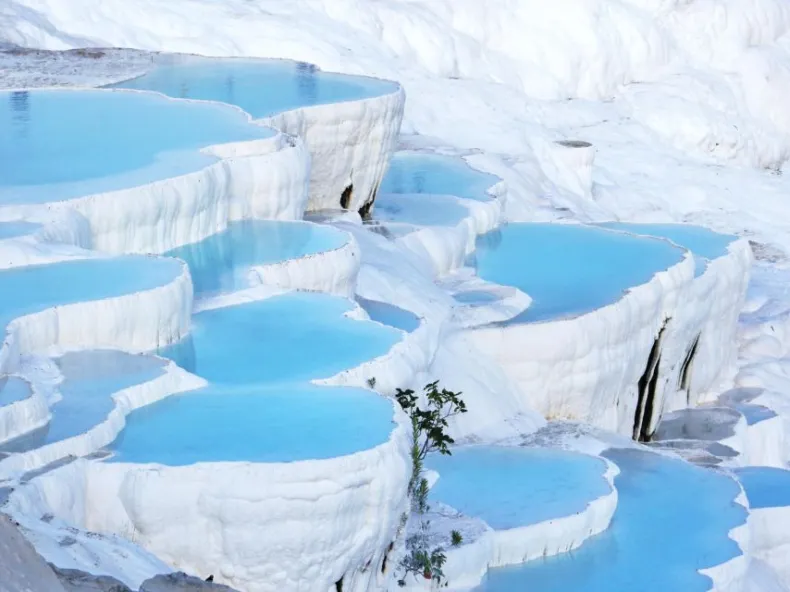
Pamukkale is entirely natural, and on most days part of it will look dry. Those two sentences do not contradict each other — they are one explanation seen from two sides. The white hillside is calcite, dropped out of hot spring water that has poured down this slope for thousands of years, and the deposit is still being laid today. There is only so much water, so it is guided across one part of the hillside at a time instead of being spread thin over all of it. A dry terrace is not a switched-off attraction. It is a terrace resting: drying hard, going bright white again, waiting its turn while another section takes the flow and the footprints.
Natural or man-made: what the UNESCO listing settles
The suspicion is fair. Nothing else on a Mediterranean holiday looks like this, the basins sit in rows too tidy to feel accidental, and one of the first things many visitors notice on arrival is water running along a managed channel. So people reasonably ask whether somebody built the thing.
The paperwork answers it. Hierapolis-Pamukkale joined the UNESCO World Heritage list in 1988 under reference 485, and it went on as a mixed property — assessed under natural criteria as well as cultural ones. That single word carries the argument. The committee judged the terraces to be a natural phenomenon in their own right, standing alongside the Greco-Roman spa city built above them rather than serving as scenery for it. Landscaping does not get inscribed that way.
What confuses people is management. The flow is steered towards whichever section is open for walking, other sections sit behind ropes, and boardwalks and signs frame the view. Every bit of that is a natural process being looked after, not an artificial one being staged. Our page on the travertine terraces follows the same story from the geology end.
How moving water builds a hillside out of stone
The springs surface warm and heavily loaded with dissolved calcium carbonate, picked up underground where hot water attacks limestone far more aggressively than cold water can. The instant that load reaches open air it begins losing carbon dioxide and cooling, and it can no longer hold the mineral in solution. So it puts it down — a film of calcite on the stone, on the algae, on a fallen leaf, on anything the water touches.
The clever part is where the film goes thickest. Deposition runs fastest at the lip of each spill, where the sheet of water thins out and turns turbulent, so every rim rises faster than the floor behind it. A shallow puddle grows a raised edge, the edge holds deeper water, that water grows its own edge, and after a few thousand years you have a hillside of scalloped bowls stacked like saucers left to overflow. Nobody drew those curves. Moving water and simple chemistry did, and they are still at it while you stand in them.
Young calcite is also soft, which is exactly why the site takes your shoes off you before it lets you onto the open section. That rule is doing real conservation work, and we explain it properly in why you walk barefoot at Pamukkale.
Why some pools are full and others are dry
Here is the honest mechanic behind the complaint you may have read in a forum. The spring output is a fixed budget. Split it evenly across the whole hillside and you get a thin, tired trickle everywhere, footprints ground into soft calcite everywhere, and grey terraces everywhere. Concentrate it on one section and that section stays brilliant — deep enough to wade, strong enough to wash itself clean — while the rest hardens and recovers its whiteness undisturbed.
So the water gets rotated. Which section is running changes over time, and a stretch that was glassy blue in somebody's photograph last year may be a bone-dry white staircase the week you arrive, and the reverse holds too. Rainfall and season shift the picture as well: the hillside after a wet spring simply carries more water than the same hillside in the tail end of a long summer.
The reassuring part, and the one that gets left out of angry reviews: the section opened for barefoot walking is a wet one. That is the point of opening it. You will not find every basin on the mountain brimming at once — that image is usually a single wet section shot from above, or one bowl framed to fill the lens — but you will find warm water to walk through, because the walk is the reason the section is open at all.
What the hillside actually looks like on the day
Expect a hillside in two tones. Where water is running, the calcite reads milky turquoise against white and the surface is slick, warm and ridged. Where it is resting, the stone is a chalky matte white that photographs beautifully in low sun and looks flat and glaring at midday. Both are the real Pamukkale; only one of them shows up in the advertising.
Expect shallow water, too. Shin-deep is a good day, and the open pools are made for standing in, sitting at the rim of and crossing slowly — the proper swim is a separate thing entirely, with its own ticket, which we untangle in can you swim at Pamukkale. If you are here for pictures, choose your frame by the light rather than hunting for the one pool from the internet; our guide to the best photo spots maps out where the white behaves.
Arrive knowing all that and the place tends to overdeliver rather than disappoint. You are standing inside a live piece of geology that has been building itself since long before anyone thought to charge admission. Our full-day Pamukkale and Hierapolis tour takes you there from anywhere between Tekirova and Gazipaşa for a flat €50 per person, with hotel pickup and drop-off, a licensed guide and three meals included; entrance tickets stay excluded and are paid at the official gates, because those tariffs are set by the site administration and change with the season. Reserve free online and pay on the day.