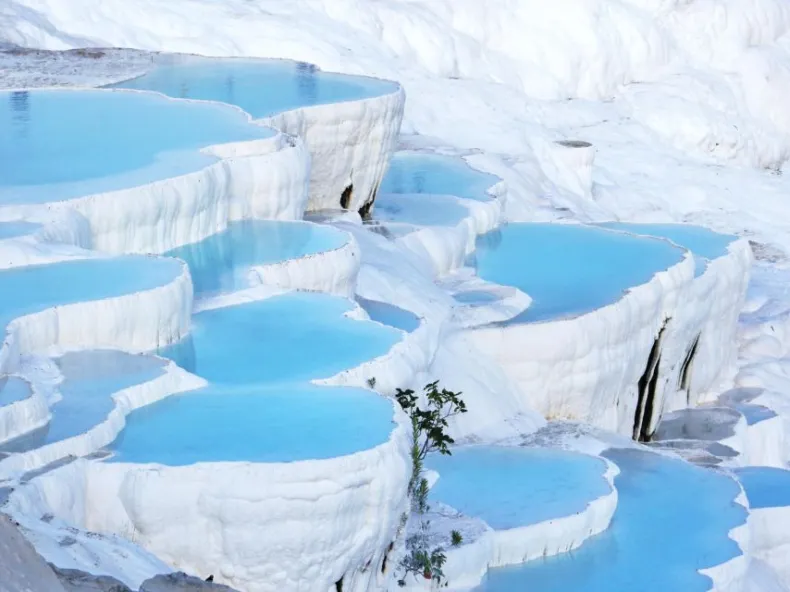
Yes, it runs. Rain does not cancel the Pamukkale day trip, and the terraces are not a venue that closes because the sky turned grey overnight. So the useful question is not the one you typed into the search box, it is the one underneath it: with a wet forecast on the screen and an early pickup already booked, do you get on the coach or do you use the free cancellation and take a drier day instead? That is a judgement call rather than a rule, and making it needs three things — what happens operationally, what rain genuinely changes on the ground, and where the deadline sits.
The operational rule, in one paragraph
The tour departs as scheduled. It runs daily from March to November and Monday to Saturday through December, January and February, with live availability in the booking calendar, and pickup is early in the morning from your hotel, the exact time reaching you with your confirmation rather than being posted on a web page. Weather is not a trigger that pulls the coach off the road. What season and operating conditions can move is the shape of the programme: Karahayıt's red springs and Lake Salda are seasonal, operational possibilities that may be added or dropped on any given day, wet or dry. The fixed core does not move — the travertine terraces and Hierapolis above them, together a mixed UNESCO World Heritage property inscribed in 1988 under reference 485. All of it is open air, which is rather the point. For the position on one specific date, WhatsApp +90 536 603 75 84 and ask a person instead of reading an icon on a phone.
The forecast you are reading is probably the wrong forecast
Your hotel sits under maritime weather. Pamukkale does not. The coach climbs over the Taurus mountains and drops onto an inland plateau in Denizli province, roughly 240 km and about 3–3.5 hours from Antalya, about 300 km from Side, around 365 km from Alanya and about 420 km out from Gazipaşa. Two weather systems, and they disagree with each other regularly. Drizzle over your resort at breakfast tells you very little about what the plateau is doing four hours inland, so before cancelling anything, search Denizli or Pamukkale by name. Our season-by-season guide to Pamukkale weather covers what the plateau typically does across the year; use that as your baseline and let the short-range forecast for the destination adjust it.
What rain actually changes underfoot
Less than you would expect in one respect and more in another. You walk the open terrace section barefoot through shallow warm water — shoes off is a site rule protecting the calcite, not a guide's preference — so your feet are wet whatever the sky is doing. Rain does not interrupt that part at all. What it does is widen the slick patches. Calcite polished smooth by flowing water is the genuinely slippery surface on any day of the year, and a wet upper surface extends how much of the route behaves that way. The remedy is unglamorous: shorter steps, and stop walking when you want to look at the view. The full picture is in our honest guide to how slippery Pamukkale really is, and it earns five minutes if anyone in your group is unsteady on their feet.
Hierapolis is where a wet day is felt more. The ancient city is spread out and exposed — the hillside Roman theatre, the vast necropolis, Frontinus Street and the monumental gates — with old paving underfoot and not much between one monument and the next in the way of cover. A packable waterproof for the top half is the single item worth adding to the bag; you are already carrying a towel for the terraces, so the rest takes care of itself.
How much of the day is outdoors anyway
Do that arithmetic before a forecast decides your week. The day measures 11–14 hours door to door, and most of it is spent on an air-conditioned coach crossing mountains. Breakfast is served during the morning drive, lunch is a sit-down meal at a restaurant near Pamukkale, dinner comes on the journey home. The exposed hours are the hours on site, which are the hours you came for. There is also one attraction where the weather barely registers: the Cleopatra Antique Pool, thermal and warm all year, with ancient marble columns lying on the bottom. Swimming there is optional and carries its own ticket bought at the gate, as every entrance ticket here does. We never print gate prices, because the site administration sets them and revises them seasonally, so carry cash. The fare itself is weather-proof: €50 per person, flat, for everyone aged 4 and over, infants 0–3 free, covering hotel pickup and drop-off, the coach, a licensed guide, travel insurance and all three meals.
The 24-hour clause is the real decision
Here is your lever, plus the detail that catches people out. Reservation is free, payment happens on the day of the tour, and cancellation is free up to 24 hours before departure. Because pickup is early in the morning, a bedtime forecast check the night before is often already inside that window. The evening that actually matters is the one two nights out. Check then and moving a wet Tuesday onto a brighter Thursday costs nothing at all; check at eleven the night before and you are deciding whether to travel, not whether to reschedule. None of the mechanics are hidden — the whole sequence is laid out in how booking works.
For what it is worth, rain almost never features in what guests are unhappy about afterwards; the recurring gripes are the length of the day and the separate tickets, both handled in what travellers complain about. Grey skies over white travertine tend to mean thinner crowds and softer light on the calcite. If the forecast is wet and the date still suits you, reserve your place on the Pamukkale tour, pay on the day, and keep that 24-hour clause in your back pocket.