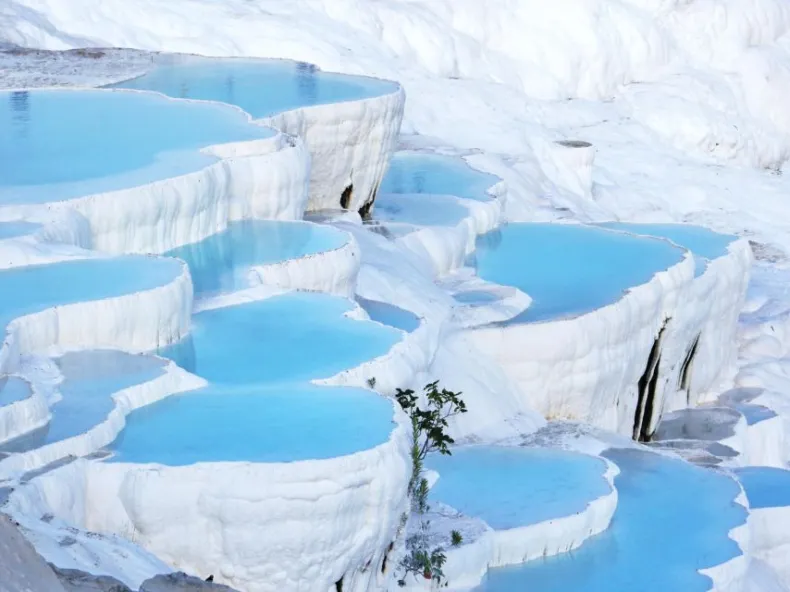
Three independent routes cover the ground between the Antalya coast and Pamukkale, and none of them is a secret: an intercity coach inland to Denizli plus a local connection up to the village, your own rental car over the Taurus, or a hybrid where you ride out and pay for a taxi on the last stretch. What follows is the shape of those routes — which legs exist, in what order they come, and where they pinch. Departure boards, fares and connections move with the season, so check them for your own date rather than trusting a number printed on any web page, including this one.
The coach route, leg by leg
Turkey's intercity coach network is genuinely good, and it is organised around city terminals — the otogar. That single fact sets the shape of this option. Pamukkale is a village in Denizli province; Denizli is the city the network serves. So the trip resolves into a chain rather than a ride: reach a terminal on the coast, cross the mountains to Denizli, then arrange local transport for the final run to the village under the terraces.
How many links that chain holds depends on where your sunbed is. From Antalya city you start at the main terminal and the inland leg begins immediately. From the Side band, or anywhere between Okurcalar and Alanya, there is normally a coastal leg before the mountain leg even starts — and that first hop is the one people forget to count while sketching the plan on a phone over breakfast. Guests staying out east towards Kargıcak and Gazipaşa add the most, simply because the inland network is built around Antalya rather than around them.
Denizli is not Pamukkale
Stepping off at Denizli's otogar is not the same as arriving. The white hill stands outside the city, above a village that carries the same name as the site, and that last connection is made locally: minibuses, the dolmuş, work the road between city and village, and taxis wait for anyone whose patience has run out. Arrange this leg in your head before you leave the coast — in both directions. It is a short piece of road and an easy one, and it is also the exact link that breaks first when the day runs late.
Once you are in the village the site is a walk away, and from there the rules are the site's own. Shoes come off on the travertine because footwear scuffs the calcite, so you wade the terrace pools barefoot; swimming happens only in the Cleopatra Antique Pool, which carries its own ticket bought on the spot. Nobody skips the entrance tickets either way — they are official, set by the site administration and paid at the gate whether you arrived by coach, by dolmuş or in your own car.
Driving it yourself over the mountains
Distances are the honest starting point, because they are the part nobody can negotiate. Pamukkale sits roughly 240 km from Antalya, about 270 from Belek, around 285 from Kemer, close to 300 from Side, some 365 from Alanya and about 420 from Gazipaşa — then all of it again, backwards, at the end of a day spent on your feet. Our page on how far Pamukkale is from Antalya splits those bands out resort by resort.
The road itself is not frightening. It leaves the humid coastal strip, climbs through pine slopes and a run of passes, then settles onto high plateau farmland before dropping towards Denizli. Lorries grind up the gradients, the air cools as you climb and warms again on the plateau, and fuel and rest stops thin out between towns. The crossing that costs you is the second one: by then the driver has walked the terraces barefoot, climbed through Hierapolis, eaten a proper lunch, and still owes the car a mountain range in falling light. If two of you can share the wheel, that changes the day more than anything else you can buy. And read the rental paperwork properly — excess, named drivers, and whether the car is allowed that far inland at all.
The return leg writes the whole day
On paper the outbound trip is the journey. In practice the way home shapes everything, because it decides the moment you have to stop looking at the terraces. Going independently means planning backwards from the last connection you are willing to trust, then making sure every link before it holds: village to city, city to coast, coast to your hotel door. Miss one and the fallback is a night in Denizli you had not budgeted for and a wasted beach morning tomorrow.
That is the real argument against squeezing it into one day on public transport, and it has nothing to do with money. Hierapolis is a full Greco-Roman city with a hillside theatre and one of the finest necropolises in Anatolia, sharing a single UNESCO listing with the terraces since 1988. It deserves unhurried hours. Spend the day's slack on connections and you spend it twice.
Which version fits your holiday
If Pamukkale is the reason you came to Turkey, go independently and give it two days: sleep in the village, meet the hill in the early light, take the road home at your own pace. That version of the trip is better than ours, and we will say so. If Pamukkale is one carved-out day inside a beach week, the coach seat exists precisely to delete the chain — pickup at your hotel door in the early morning with the exact time confirmed on your booking, an air-conditioned coach over the passes, a licensed guide through the terraces and Hierapolis, travel insurance and three meals: breakfast outbound, lunch near the site, dinner rolling home. It is a flat €50 per person for everyone aged 4 and over, with infants 0–3 free, from thirty pickup areas between Tekirova and Gazipaşa.
Weigh the two properly in our guided tour versus DIY comparison, put your own figures against the cost breakdown, and if the seat wins, reserve it free online and pay on the day of the tour. If it does not, take the road anyway — the hill is worth reaching by any means.