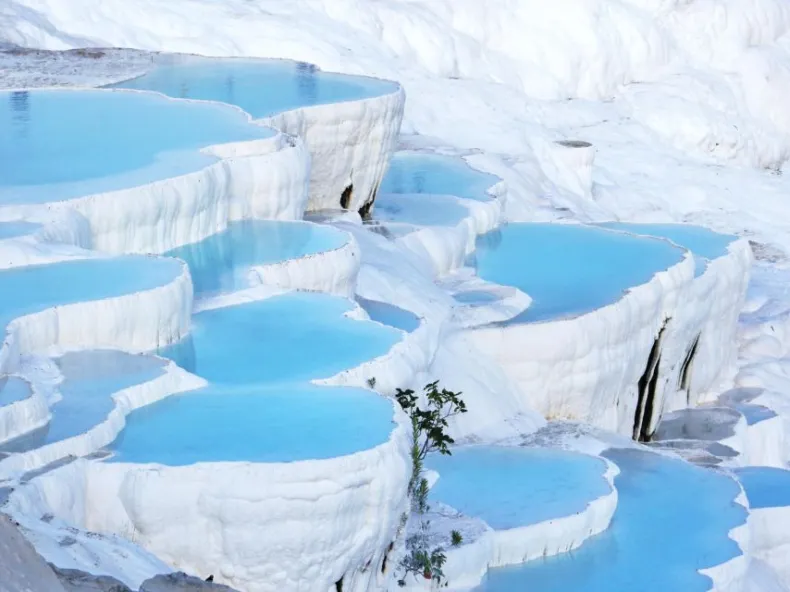
Two different things get called "walking" on this day, and they tire you in different ways. One is endurance: door to door the trip runs roughly 11–14 hours, most of it seated, and by evening even keen walkers go quiet in the back rows. The other is footing — a wet barefoot slope of calcite, then a Greco-Roman city spread across ground that nobody has resurfaced in two thousand years. Neither part is a hike, and large stretches of both are genuinely optional. What follows describes the conditions rather than awarding an accessibility rating, because no operator can honestly hand one out for a protected natural surface on a hillside.
The long sit comes before the short walks
Guests planning around a hip, a bad back or a recent operation usually assume the terraces will be the problem. Often it is the coach. Pickup is early in the morning, with your exact time confirmed alongside your booking, and the road turns inland across the Taurus mountains — roughly 3–3.5 hours each way from Antalya, nearer 4.5–5 from the Alanya band. Rest stops break the drive up, breakfast is served on the way out and dinner on the way back, but if staying still is what hurts you, that is the half of the day worth thinking hardest about.
Two small things help more than they sound like they should. Ask us in advance for a seat near the front, where the ride is steadier and the aisle is short. And stand up at every stop, including the ones you do not need — a few minutes upright stops knees and ankles from setting. Boarding is by steps with a handrail and there is no lift; an arm to hold is the realistic aid, and drivers here are used to giving people their time. Everything else the day covers — guide, insurance, three meals, drop-off at your own door — sits on the what-is-included page.
The white slope: barefoot, wet, kinder than the photographs
Shoes come off at the entrance to the open terrace section, because bare soles are gentler on soft calcite than rubber ever is; the barefoot rule is a conservation measure with an unexpected side benefit for balance. The walked route drops down the hillside and comes back up the same way, through shallow warm water over ridged stone. There are no handrails on it, and no set distance you are obliged to finish. Plenty of visitors go a short way in, stand in the water, take their photographs and turn round; the guide gives you a meeting point rather than marching you to a finish line.
The genuinely slick ground is narrower than people fear — the polished channels where the water runs fastest, visible by eye and easy to step around. Our separate piece on how slippery it really is works through that surface by surface. For mobility, three facts matter. A stick with a rubber tip does very little on wet calcite. The slope is a slope in both directions, so the return is the harder leg. And wheels of any kind do not go onto the terraces: the calcite is soft and protected, and this is the one section of the day that cannot be adapted for anybody.
Hierapolis is huge, and most of it is your choice
Above the springs stands Hierapolis, the ancient spa city that shares the 1988 UNESCO inscription with the terraces as a single mixed World Heritage property, reference 485. Huge is the operative word: a colonnaded street, monumental gates, temple and church remains, an enormous necropolis at the far end and the Roman theatre cut into the slope above. Ancient paving is uneven by definition — sunken slabs, loose stone underfoot, long open stretches where the shade runs thin and the sun does half the tiring for you.
The saving grace is that the guided walk is a route, not a requirement. Guests regularly do the near section and stop there — a bench, a cold drink, somewhere out of the sun — while the rest of the party carries on up to the theatre, whose approach climbs and whose seating is stepped. Agree a meeting point with your guide at the start and the day stops being all-or-nothing, which is the single most useful trick for a family travelling across three generations. The Cleopatra Antique Pool sits in this upper area as well: warm mineral water that many people with stiff joints find generous, entered by steps, on its own ticket bought at the gate. The swim is optional, and so is the walk to it.
Wheelchairs, sticks and walking frames — the straight answer
We do not sell this as an accessible tour and we are not going to imply that it is. The vehicle has steps and no lift. The terraces take no wheels. Parts of Hierapolis are firm and level enough to be managed with help, other parts are not, and nobody can promise which paths will be dry, open or under maintenance on your particular date. Anyone answering "yes, fully accessible" to a question like this has not stood on the hillside.
What we can do is talk about your actual situation instead of a category. A folding chair with two strong relatives is a different conversation from a powered one; a knee that hates stairs is different again from a back that hates sitting still. Send us a message on WhatsApp (+90 536 603 75 84) saying what the person can manage — steps, minutes on their feet, whether they can get in and out of a coach seat — and we will tell you plainly which parts of the day work for them and which do not. If the honest answer is that this trip is the wrong one, we would rather say so now than take €50 from you on the morning.
Booking it without committing yourself
None of this has to be decided in advance. Reservation is free online and payment happens on the day, with free cancellation up to 24 hours before departure, so you can hold places on the full-day Pamukkale and Hierapolis tour while a knee settles down or a grandparent thinks it over, then step back at no cost if the week goes the wrong way. The flat €50 applies to everyone aged 4 and up, infants 0–3 travel free, and entrance tickets are paid at the gates — so somebody who decides to sit in the shade with a coffee while the others go down the slope has paid for exactly the day they had.