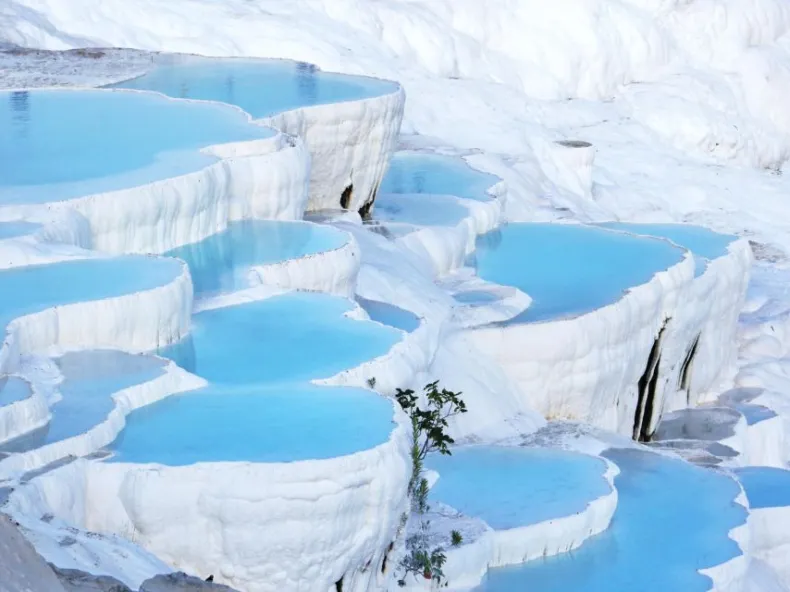
If you could order a custom-built Pamukkale day, it would look a lot like October: sunshine without the fight, white terraces without the densest crowds, and thermal water that suddenly feels like a gift rather than a novelty. November continues the same offer in a quieter register. Autumn is the window when the site gets almost everything right at once — here is what that actually means on the ground.
The light changes first
High summer light at Pamukkale is spectacular but blunt: overhead, glaring, hard on the eyes and flattering to nobody's photographs by midday. In autumn the sun sits lower and the light turns softer and more directional, raking across the terrace rims instead of flattening them. The white hill picks up warmth and shadow, the sky behind it deepens, and pictures start looking the way you imagined them before you came.
Photographers talk about autumn's skies for another reason: weather begins to move again. Instead of the fixed blue dome of August, you get clouds with shape and drama drifting over the plateau. When they break, the terraces light up in patches — a slow natural light show that summer simply never stages.
Warm water, cooling air: the season's party trick
The spring water at Pamukkale emerges warm all year round. In July that fact is pleasant; in late October it becomes the whole point. As the plateau air cools, stepping barefoot into the shallow terrace pools shifts from refreshing to quietly luxurious — warm water around your ankles while the breeze carries the first real bite of the coming winter.
On the cooler days you may catch the site's famous preview: faint steam beginning to lift off the pools where warm water meets chilling air. It is the opening act of the full winter spectacle, and if that image tempts you, the winter guide shows where the show goes from here. Wading stays exactly as it is all year — shoes off on the designated open section, shallow water, no swimming outside the optional Cleopatra Pool.
Hierapolis without the hurry
The ancient city above the terraces is the part of the day that gains most from autumn. Hierapolis is enormous — a Greco-Roman spa city with a hillside theatre and one of the largest ancient cemeteries in Anatolia — and walking it in comfortable air, with room around you, is a different experience from marching it in August heat.
The guide's stories land better too. Standing in a quieter theatre, you can actually hear the scale of the place; in the necropolis, the long rows of tombs feel contemplative rather than crowded. This is the season for travellers who came for the history as much as the terraces.
The practical picture for autumn
The logistics stay generous deep into the season: the tour runs daily right through November, moving to its Monday-to-Saturday winter rhythm only from December. The formula does not change — hotel pickup in the early morning, breakfast on the drive, a licensed guide through the site, lunch near Pamukkale, dinner on the return, all inside the flat €50 per person, with infants aged 0–3 free and entrance tickets paid separately at the official gate price.
Packing needs one small update: layers. Mornings and evenings on the road are cool, middays at the site are often still warm, and the terraces themselves ask for nothing but bare feet and a towel to dry them. A light jacket you can stuff into a bag covers the whole day. Book with the usual freedom — free online reservation, pay on the day, free cancellation up to 24 hours before departure.
One honest programme note for the season: the day's core never changes — terraces, guided Hierapolis, three meals — but the routing can flex with operating conditions, and bonus stops such as Karahayıt's red springs or Lake Salda may be added or removed. Autumn is exactly the kind of transitional season where such adjustments happen, so treat any extra stop as a gift rather than a promise. The drive itself joins the show in these months, too: the Taurus crossing picks up autumn colour, and because evenings arrive earlier, dinner on the return leg often rolls through proper dusk — mountains fading to silhouettes outside the window while the coach hums home. Many guests name that stretch, unprompted, as their favourite hour of the day.
Is autumn the best season, full stop?
It is the most balanced one — the month range where light, temperature and crowd levels meet in the middle. Whether it is the best for you depends on what you are optimising: summer wins on sky-blue drama and long evenings, winter wins on solitude and steam. Our season-by-season guide to the best time to visit Pamukkale makes the honest case for each.
But if your holiday happens to fall in October or November, count yourself lucky rather than late. The season is not winding down; it is settling into its most comfortable form — softer light on the white hill, warm water underfoot, and an ancient city with space to think. Autumn is not Pamukkale's leftovers. It is arguably the main course.