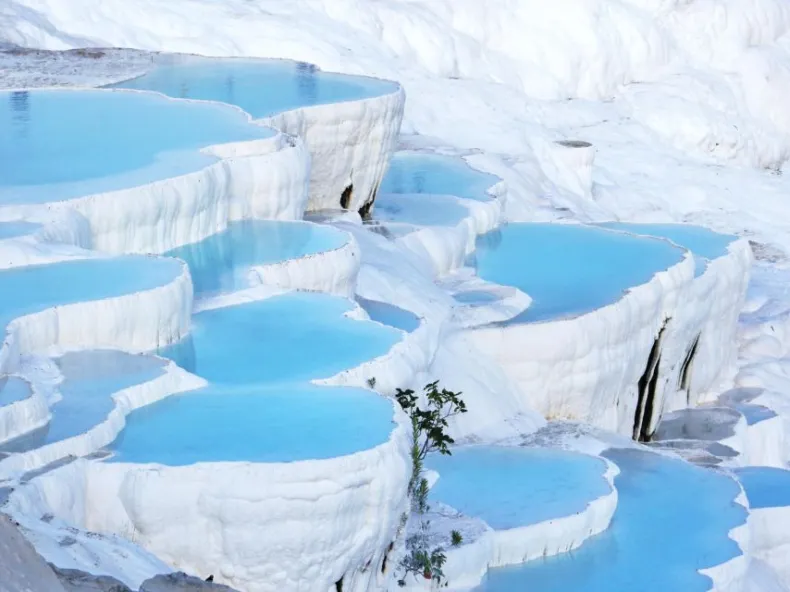
For most travellers, yes — Pamukkale is worth it. The white travertine terraces are a landscape that exists almost nowhere else on Earth, the ruins of Hierapolis above them are far grander than most people expect, and together they form a single UNESCO World Heritage Site, inscribed back in 1988. The honest caveats are three: it is a long drive from the coast — long, but still short enough to sleep in your own bed, which is more than Ephesus can manage from these hotels — the middle of the day gets crowded in season, and the site is bigger and more demanding than the photos suggest. Whether it is worth it for you depends on how you weigh those three things — so let us weigh them properly.
What genuinely wows
The first sight of the terraces from below is the moment nobody forgets. A whole hillside of white calcite, streaked with pools, looking like a glacier that took a wrong turn into the Aegean hinterland. Then you take your shoes off — it is a site rule that protects the calcite — and walk into it, and the surprise doubles: the stone is textured and ridged underfoot, the water in the open section is warm and shallow, and you wade through it rather than look at it from a rope line. Very few famous landscapes let you touch them like this. The travertines page goes deeper into how the terraces formed.
There is a third, quieter wow the photographs cannot carry: the terraces are alive. The same mineral-rich springs that built the hillside over millennia are still flowing, still leaving their thin white films of calcite — you are not inspecting a preserved relic but standing inside a process that never stopped. Very few places on Earth let you watch geology work on a human timescale, let alone paddle in it while it happens.
The second wow is the one people don't plan for: Hierapolis. The Greco-Roman spa city above the terraces has a hillside-carved Roman theatre in a remarkable state of preservation, a vast necropolis that ranks among the best-preserved ancient cemeteries in Anatolia, and colonnaded streets you can walk at your own pace. Many guests arrive for the white pools and leave talking about the ruins. Add the option of swimming among submerged marble columns in the Cleopatra Antique Pool — a separate ticket, bought on site, entirely optional — and the day stacks three very different experiences on one hilltop.
What to expect realistically
Now the other side of the ledger, because a verdict without it is advertising. First, the drive: roughly 240 km each way from Antalya city and up to 420 km from the far east of the coast, which makes the door-to-door day roughly 11–14 hours. On the guided tour that time is padded with breakfast on the road, lunch near the site and dinner on the way back, but it is still a long day, and pretending otherwise helps nobody.
Second, the crowds. Pamukkale is one of the most visited places in Turkey, and in high season the late-morning-to-afternoon window is busy — that is simply what a world-famous site looks like in July. The terraces absorb people better than a narrow street would, and Hierapolis is so large it swallows crowds whole, but if you expect a private infinity pool from an influencer photo, reality will correct you.
Third, the scale and the surfaces. The photos compress Pamukkale into one pretty terrace; the actual site is a broad hillside plus an entire ancient city, walked on bare feet below and on uneven old stones above. Comfortable shoes for the ruins, sun protection, and a realistic sense of your own walking appetite matter more here than at any beach stop.
Who will love it — and who might skip it
You will very likely love Pamukkale if any of these sound like you: you enjoy places with real history rather than built attractions; you want one day of your beach holiday to produce the photos and stories the other six won't; you are travelling with kids who can wade in warm shallow water for an hour and call it the best day of the trip; or you simply want to stand somewhere that looks like nowhere else you have been.
You might honestly skip it if long coach days are misery for you regardless of what is at the end of them, if severe mobility issues make barefoot slopes and uneven ancient streets more risk than joy, or if your idea of a perfect holiday never leaves the pool bar — no judgment, but this is a day for the curious. Travellers in the middle — interested but wary of the logistics — are exactly who the guided format was built for: hotel pickup, a licensed guide, insurance and all three meals are included in the flat €50 per person, so the long day arrives organised rather than improvised.
The verdict
Worth it — clearly, for most people, and especially in the guided one-day format that removes every practical excuse. The terraces alone justify the trip; Hierapolis turns it from a photo stop into a proper day of travel. Go in with honest expectations about the drive and the midday buzz, and Pamukkale delivers something no other day out from the Antalya coast can. The commitment is lighter than the day is long: reserving costs nothing, you pay only on the day of the tour, and cancellation is free up to 24 hours before departure — so the decision costs nothing to make and very little to unmake. When you are ready, you can reserve your place online for free and pay on the day — or start with the ultimate guide if you want every detail first.