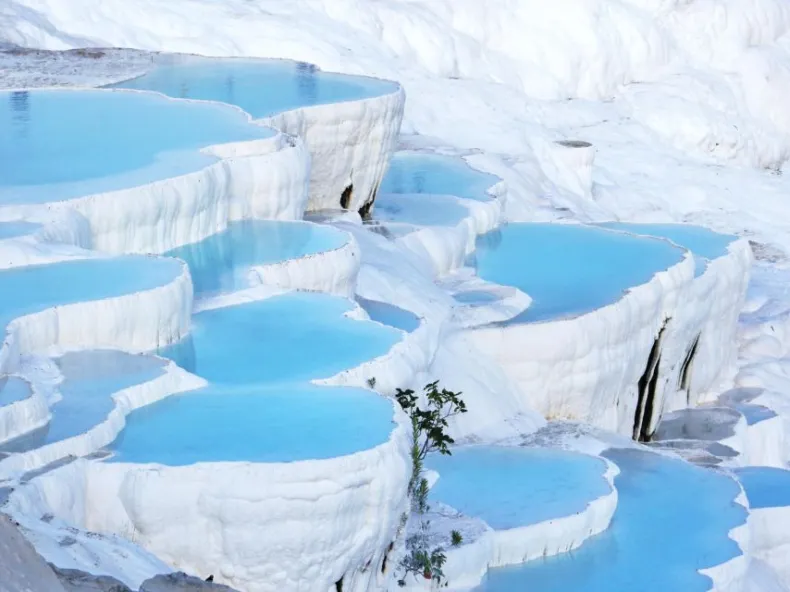
Lake Salda is the stop passengers photograph through the coach window before anyone has explained it: a deep mountain lake in Burdur province, ringed by shores so white they look borrowed from the terraces you are on your way to see. Some seasonal routings of the Pamukkale day add a Salda stop; many do not, and it is never guaranteed. Here is what the lake actually is, what a stop involves, and why its resemblance to Pamukkale is a happy coincidence rather than a family tie.
What Lake Salda is
Salda is a crater-like freshwater lake near the town of Yeşilova, sitting high among the hills roughly along the inland route between the coast and Denizli province. Its two signatures are colour: water that shades from pale turquoise at the rim to deep blue-green at the centre, and shores of soft white mineral deposits that glow against the surrounding pine slopes.
The lake has earned genuine scientific fame — researchers have studied its unusual mineral shorelines with great interest — but you do not need a laboratory to enjoy it. You need a viewpoint, a stretch of white shore and a few unhurried minutes, which is precisely what a tour stop provides.
The approach is part of the pleasure. Salda announces itself suddenly: the road runs through ordinary hill country — pine, field, rock — and then a bend opens onto a bowl of improbable colour sitting in the landscape like a misprint. Coaches tend to go quiet for a moment when it appears. Bring sunglasses even in the cool months, because the white shore throws light around generously, and keep your camera reachable rather than stowed: the first full view from the road is often the best wide shot of the whole stop. The gradient photographs exactly as you see it — pale rim, deepening centre, no filter required and none believed anyway. Children, for the record, rate the soft white ground somewhere between snow and beach; expect requests to stay longer. Season frames the scene as well: spring sets green hills behind the white rim, autumn deepens the blues, and the cooler months trade warmth for even cleaner light — the lake has no bad month, only different framings.
Sister in colour, not in origin
Here is the part worth getting right, because the two whites genuinely confuse people. Pamukkale's travertine terraces are built by flowing thermal water: warm, calcite-rich springs pour down a hillside and shed stone as they cool, sculpting basins over millennia. Salda's white is lake chemistry — mineral deposits formed at the water's edge, a shoreline phenomenon rather than a flowing one.
So the resemblance is real but skin-deep: same colour, different story. One is a warm cascade you wade through barefoot; the other is a cool mountain lake you admire from its rim. Travellers who see both on one day get a small geology lecture written across the landscape — the full side-by-side lives in our Pamukkale vs Lake Salda comparison.
What a stop actually looks like
When a routing includes Salda, think of it as a breathing pause built around a view: the coach pulls in, and you get time at a viewpoint or down along a stretch of the white shore. People photograph the colour gradient, walk the soft pale ground, touch the water and mostly just stare — the lake has a stillness that suits the middle of a long travel day remarkably well.
Set expectations accordingly: this is a viewpoint-and-shore stop, not a second destination. There is no barefoot terrace ritual here, no guided ancient city and no swimming programme on this itinerary — the day's only swimming venue remains the optional Cleopatra Pool at Hierapolis, with its own on-site ticket. Salda is the interlude, Pamukkale the show. Our Lake Salda page holds the fuller portrait.
Why it is never guaranteed
The honest mechanics: the Pamukkale tour's core programme is fixed — terraces, guided Hierapolis, three included meals — while the programme can change with season and operating conditions. A Lake Salda stop is one of the elements that may be added or removed operationally, exactly like Karahayıt's red springs on other routings. No version of this page will promise it to you, because the road, the season and the day's logistics get the final word.
The fair way to weigh it: book the day for what is always in it, and let Salda be the occasional gift. The flat €50 per person — coach, licensed guide, insurance, breakfast, lunch and dinner — buys the same complete day whether or not the white lake appears through the window, and infants aged 0–3 join free either way.
The bottom line
Lake Salda is a genuinely beautiful anomaly: a white-shored mountain lake moonlighting as a preview of the white hill you are travelling towards. If your date's routing includes it, you get one of Türkiye's most photogenic pauses at no extra cost; if not, your day is precisely as complete as everyone else's. Reserve your Pamukkale seat online for free, pay on the day, and treat any glimpse of Salda's improbable shoreline as the bonus track — never the album.