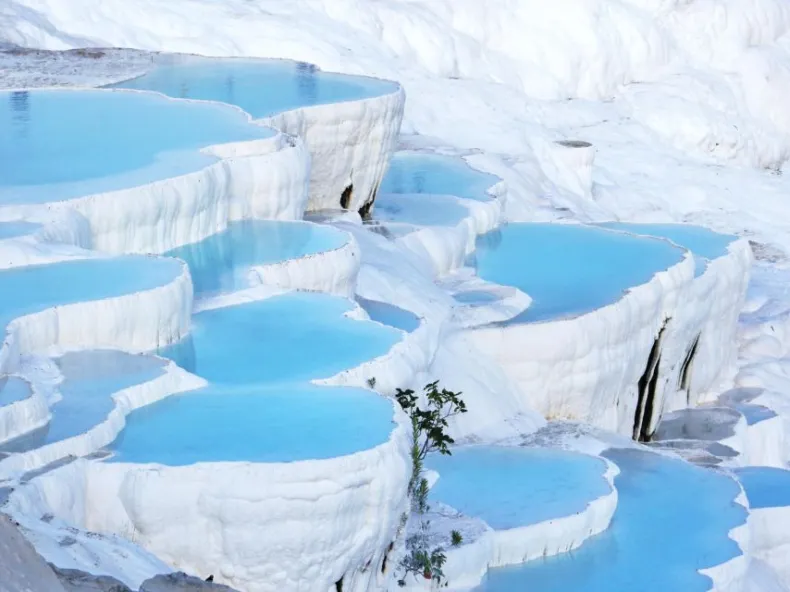
Pamukkale and Hierapolis are two names for one hillside. Pamukkale is the white travertine terraces at the bottom of the slope; Hierapolis is the Greco-Roman spa city standing on the plateau directly above them. UNESCO listed the pair together in 1988 as a single mixed World Heritage property — Hierapolis-Pamukkale, reference 485 — and on the ground that means one fenced site, one entrance, one ticket that admits you to both, and one day that comfortably holds them. You are not being sold half a thing twice.
The terraces below, the city above
Stand at the foot of the hill and what you see is Pamukkale: a slope of blinding white shelves, pool stacked on pool, built up over an unhurried number of centuries as calcite-heavy spring water spilled downhill and left its mineral behind. Turkish calls the result the cotton castle, which is a lovely name for something that up close feels nothing like cotton — chalky, ridged, faintly warm under bare feet where the water still runs. If the process interests you, how the terraces form is the page for it.
Now walk up. Those same springs kept flowing across the plateau at the top, and roughly two thousand years ago that was reason enough to found a city there — a spa city, begun under Hellenistic kings and enlarged into a wealthy Roman one. That city is Hierapolis: a theatre cut into the slope, a long colonnaded street running between monumental gates, temple foundations, the walls of early churches, and a cemetery spreading along the northern road. Its story reads in about the time it takes to drink a coffee, and we have written it out at Hierapolis in five minutes.
So the difference is vertical rather than geographical. One is what the water made on its own; the other is what people built in order to live beside it. Neither makes much sense without the other, which is exactly why the listing treats them as one property rather than two.
One gate, one ticket, one visit
This is the part that worries travellers, so let us be blunt about it. The terraces and the ruins sit inside the same archaeological area, behind the same fence. A single entrance ticket admits you to both. There is no inner barrier where the calcite stops and the ancient street begins, no second desk, no second fee for crossing between them — you simply keep walking uphill and at some point you are in a Roman city.
Two things genuinely are separate, and it is worth knowing which. The Cleopatra Antique Pool, the warm pool with ancient marble columns lying on its floor, carries its own ticket bought on the spot if you decide to get in. Museum entries are ticketed on their own as well. Everything else is covered by that one admission.
We deliberately keep all of these outside our tour price. Official gate rates are set by the site administration and shift with the season, so we would rather you paid the true figure at the window than an inflated guess quietly folded into ours. What that looks like in practice, and roughly what to carry, is set out on the entrance tickets page.
Why every listing prints both names
An excursion advertised as "Pamukkale and Hierapolis" is not two excursions bolted together with a shared coach. It is one day, named honestly. Some operators put Pamukkale first because that is the photograph everyone recognises. Others lead with Hierapolis to signal that a guide is going to walk you through the ruins rather than drop you at the terraces for twenty minutes of pictures. Same site, different emphasis in the marketing.
The real differences between listings live somewhere else entirely: how far the coach has to come, whether meals are handled or left to you, whether the guide is actually licensed, and how much of the afternoon you get to keep for yourself. Those are worth comparing line by line. The two place names are not — if a seller implies that Hierapolis is an extra you can bolt on for a fee, they are inventing a product.
What the pair looks like on a day tour from the coast
On our full-day trip you are collected from your hotel early in the morning, with the exact time confirmed when your booking is confirmed — it depends on your address and on the order the vehicle drives that day. Breakfast is served on the road while the coach climbs inland across the Taurus mountains, so you arrive with most of the daylight still in front of you.
Most groups take the terraces first, shoes in hand. You wade the shallow open section barefoot, which is a site rule protecting the calcite rather than a piece of local colour, and the water is warm enough that nobody hurries. Then comes the walk up into the ancient city with a licensed guide — theatre, street, gates, necropolis — and lunch at a restaurant near the site. The free time afterwards is genuinely yours: a swim among fallen columns in the Cleopatra Pool for some, more ruins for others, a bench and a view for the rest. Dinner is served on the journey home, and the day ends at the door you were collected from.
€50 per person, flat, from every one of our thirty pickup areas between Tekirova and Gazipaşa. Everyone aged 4 and over pays that; infants aged 0–3 come free. There is no child rate, because there is nothing to discount off a single honest number. The fare covers the round-trip coach, the licensed guide, travel insurance and all three meals; entrance tickets and drinks are yours. Season and operating conditions sometimes add the red springs at Karahayıt or the white shores of Lake Salda to the route — a bonus when it happens, never a promise. Departures operate every day from March to November and Monday to Saturday through the winter months, you reserve free online and pay on the day, and cancellation is free up to 24 hours before departure. Check your date and reserve, or put the question to us on WhatsApp at +90 536 603 75 84.