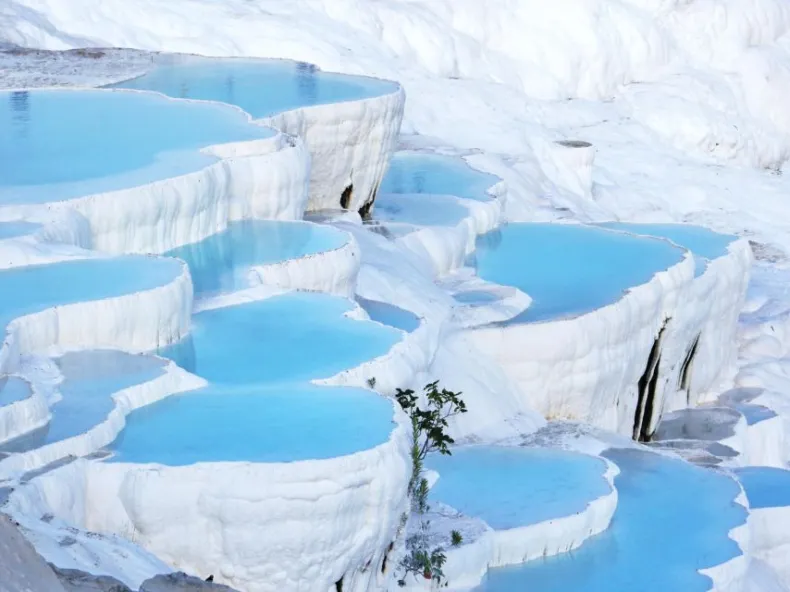
April is the start of the season rather than the middle of it, and that one fact explains almost everything about a Pamukkale day in this month. Departures have been running daily since March, the coach is rarely full, the plateau inland is still green from the winter rain, and the white hillside gets to be a landscape instead of a queue. What April does not hand you is the postcard with warm water around your ankles. That is the trade, and it is worth understanding before you pick your date.
You are weeks ahead of the crowd
The clearest advantage of an April date shows itself the moment you step onto the calcite: space. The same stretch of terrace that will carry a steady stream of visitors six weeks later can be walked at your own pace, and Hierapolis above it — the Greco-Roman spa city with its hillside theatre, its street of monumental gates and its vast necropolis — is close to the version you pictured while reading about it. You can stand still in the theatre without becoming an obstacle.
Quiet is not the same as empty. Pamukkale is a UNESCO World Heritage property, inscribed in 1988, and it never truly empties. But the yearly rhythm has not tightened yet, and our guide to when the site is genuinely quiet sets out how that rhythm behaves across twelve months.
The temperature gap that catches people out
Here is April's most common surprise. You are collected early in the morning from a resort where the sea is warming up and the loungers are filling. By the time the coach has crossed the Taurus mountains you are on high ground in Denizli province, and the interior has not caught up with the coast yet — spring reaches a sheltered shoreline well before it reaches a plateau. Board the coach in beach clothes and you will spend the afternoon hugging your arms on an exposed hilltop.
The fix is one thin layer, packed and then forgotten about. Everything behind that advice is on our Pamukkale weather page, and the full outfit — shoes that come off easily for the terraces, real walking shoes for the ancient city, a small towel for your feet — is reasoned out in what to wear.
The honest note about the water
The springs that feed the terraces are thermal and emerge warm all year; that is what built the hill in the first place. What changes is how that thin sheet of water feels once it has spread across a calcite slope that has spent an April night cooling in plateau air. Early in the season the wade is bracing rather than bath-warm, and the travellers who come away mildly disappointed are almost always the ones who arrived planning to stand in it for a long, blissful while.
If warm water is your main reason for going, two things. The place that is famously warm in every season is the Cleopatra Antique Pool above the terraces, where swimming is genuinely swimming — optional, with its own ticket bought on site. And check whether your dates can slide later: May and the months after it deliver that sensation far more reliably. On the terraces themselves you wade in any month, whatever the calendar says.
Rain is possible, and the tour still goes
April weather on the plateau genuinely moves, so a wet day is a real possibility rather than a theoretical one. Two things follow. The tour runs: a large share of the day is road, meals and a guided walk through a site, and a shower does not tip that over — the detail lives on our page about what happens when it rains. And a damp April morning tends to hand you the emptiest Hierapolis of your life, followed, when the cloud breaks, by a rinsed clarity over the white hill that a fixed summer sky never produces.
Who April suits — and who should wait
April is a walker's month. If a good day out means covering ground on foot without rationing your energy, the air is on your side here in a way it simply is not in July, and the long circuit through the ancient city costs you much less energy. Photographers win for the same reasons walkers do: green plateau, moving light, few people in the frame. So does anyone who dislikes crowds enough to trade something else for elbow room.
Wait, on the other hand, if your mental picture of Pamukkale is bare feet in warm water for an unhurried afternoon, or if you are travelling with small children who would rather sit and splash than walk. Those trips land better in the warmer half of the season. The wider seasonal argument is in our spring guide, and all four seasons are weighed side by side in the best time to visit Pamukkale.
The practical April picture
Structurally nothing changes for April. Departures are daily from March through November, the day runs roughly 11–14 hours door to door depending on which resort collects you, and pickup is early in the morning with the exact time confirmed with your booking rather than guessed at on a web page. Breakfast is served on the drive, lunch near the site, dinner on the way home, and a licensed guide is with you throughout — all inside a flat €50 per person for everyone aged 4 and over, with infants 0–3 free. Entrance tickets are not included: they are official, set by the site administration, change with the season and are paid at the gate at the real price.
The programme note applies in April as in every month. The core day is fixed, while operational extras such as the red springs at Karahayıt or a stop at Lake Salda may be added or dropped with the season and the day's conditions, and are never promised. To hold a date, reserve online for free and pay on the day of the tour, with free cancellation up to 24 hours before departure — which, in a month whose forecast can turn twice in a week, is a more useful feature than usual.