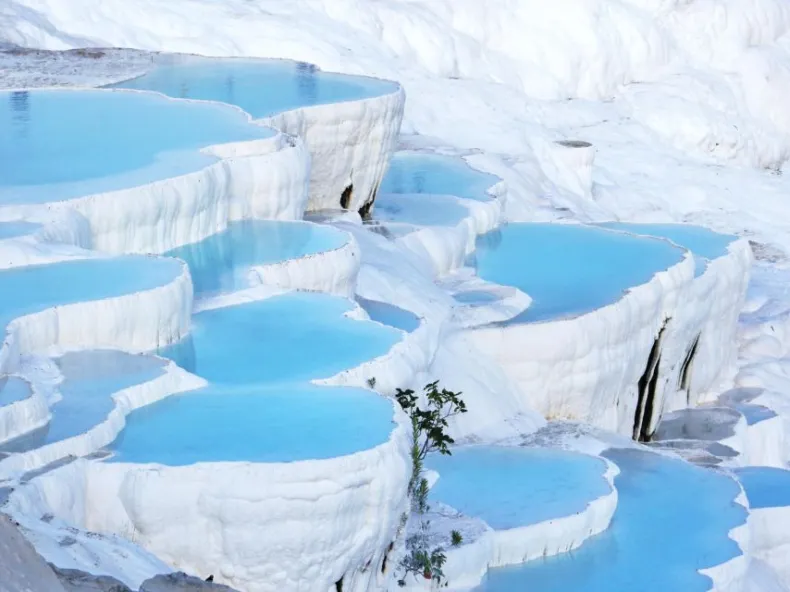
September is the seam in Pamukkale's year. The school-holiday wave drains away, the coast keeps every bit of its energy, and the white hillside gets its mornings and afternoons back — without asking you to give up anything in return. If you are torn between a summer visit and an autumn one, this is the month that quietly borrows from both, and the reason has less to do with the sky than with the school calendar.
The calendar does most of the work
Nothing about the terraces changes on the first of the month. What changes is who is standing on them. Through July and August the whole coast runs on family time: holidays across Europe overlap, resorts fill to the brim, and every inland excursion carries a share of that traffic. By the second week of September the overlap has come apart. Parents are back at school gates, couples and older travellers take their seats instead, and the coach that leaves the Mediterranean has a noticeably different mood in it.
That shift travels all the way to the site. The most photographed stretch of terrace still gathers a crowd — it always will, and any page that tells you otherwise is selling something — but the pressure comes off the edges and the day stops feeling like a queue. Our guide to Pamukkale crowds and when it is genuinely quiet sets out the two rhythms at play, the yearly one and the daily one. September is where the yearly rhythm starts working for you without any planning on your part.
One day, two climates — pack for both
Here is the trap first-timers fall into. You set off from a Mediterranean resort while the morning is still soft, and a few hours later you are standing on an inland plateau in Denizli province, on the far side of the Taurus mountains. Inland September does not behave like coastal September. The plateau lets go of its warmth quickly once the light goes, and this trip starts before sunrise and finishes well after dark.
So: layers, not outfits. A light long sleeve or a jacket you can carry rolled up all day earns its space twice over — once against the air conditioning on the coach, once on the return leg when the windows have gone black. Sun protection stays non-negotiable even as the fierceness fades, because the terraces are white calcite and throw the light straight back up at you. You walk that section barefoot, since shoes come off to protect the surface, so pack something to dry your feet with afterwards. Readers of our summer heat playbook will recognise half this list; September just adds a layer at each end of the day.
What the visit itself feels like this month
The wading is unchanged and still the heart of it: shallow mineral water running over your ankles, the hill falling away below, the whole thing brighter than any photograph prepares you for. The one clarification worth repeating is that the terrace pools are for walking, not for a proper dip; a real swim means the optional Cleopatra Antique Pool above them, with its ancient columns underfoot and its own ticket bought at the site.
Hierapolis is where the month pays out most obviously. The Greco-Roman spa city above the springs is huge, and in the crush of high summer most visitors experience it as a march between two photo stops. Give it September conditions and it turns back into a city: you can stop where the guide stops, stand in the hillside theatre long enough to feel its scale, and walk out along the necropolis without stepping around anyone. Travellers who came for the ruins as much as the white hill notice the difference immediately.
How September compares with the months on either side
Be honest about the trade. October and November go quieter and softer still, and the steam that lifts off the pools in the cold — the image that makes winter here famous — is not yet part of the show. What September holds over those weeks is fullness: the coast is completely awake, restaurants and beach clubs still have their whole staff, and departures run every day rather than on a winter rhythm. Nobody is packing anything away yet.
Against August the argument is simpler still. The same hillside, the same guide, the same three meals — with room to breathe and better hours for photographs. For the full season-by-season case, the best time to visit Pamukkale guide compares all four without wishful thinking, and if your dates could slide a few weeks later, read the October and November guide before you decide.
Booking a September day, practically
Departures run daily from March to November, so a September date is a matter of choosing, not chasing. The day is long by design — roughly 11–14 hours door to door depending on which of the 30 pickup areas between Tekirova and Gazipaşa you are staying in. Pickup is early morning from your hotel, and the exact time for your hotel is confirmed with your booking rather than guessed at on this page.
The price holds its shape all year: €50 per person from every pickup area, for everyone aged 4 and over, with infants 0–3 travelling free. That covers hotel pickup and drop-off, the coach, a licensed guide, travel insurance and three meals — breakfast on the drive, lunch near Pamukkale, dinner on the way home. Entrance tickets are deliberately not included, because official gate prices are set by the site administration and move with the season; you pay the real tariff at the ticket office instead of a padded guess buried in ours. Drinks are separate too, so keep some cash handy. Depending on season and operating conditions the programme may pick up a stop at the red springs of Karahayıt or at Lake Salda — a bonus when it happens, never a promise.
Reserve free online and pay on the day of the tour, with free cancellation up to 24 hours before departure; September dates on the Pamukkale tour from Antalya fill steadily rather than suddenly, so booking early costs you nothing and settles the question. If you would rather ask a human first, WhatsApp us on +90 536 603 75 84.