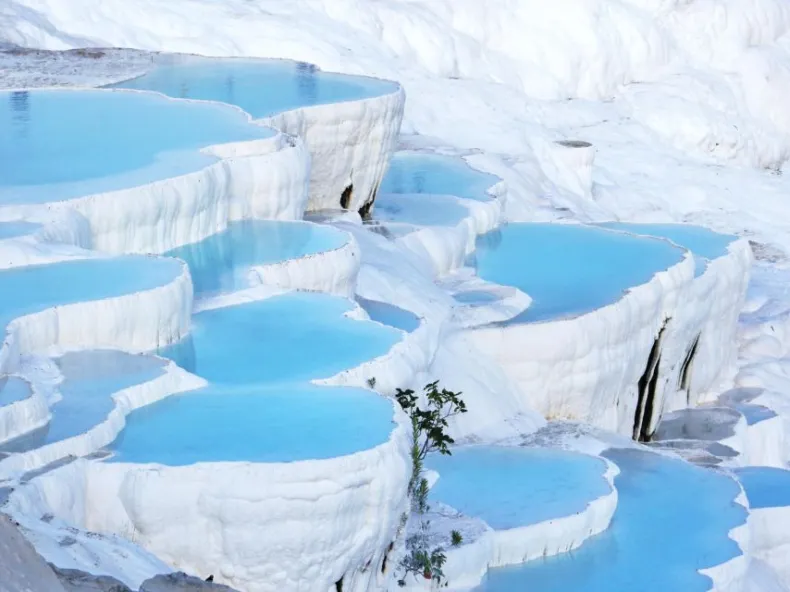
Infants aged 0–3 travel free on the Pamukkale day trip. That settles the money half of the question in one line: nothing is charged for a baby, there is no infant supplement and no paperwork to produce at the door. The practical half needs longer, and it opens with a warning worth more to you than the fare — leave the pushchair at the hotel. The open terrace section is walked barefoot, wheels have nowhere to go on it, and a carrier is what turns this day from a wrestling match into an ordinary outing with a baby strapped to your chest.
What free actually means on this booking
Free means not charged. Everybody from the age of 4 upwards pays the same flat €50, whichever of the 30 pickup areas between Tekirova and Gazipaşa your hotel sits in, and there is no reduced junior rate underneath that figure — the bands and the family arithmetic are laid out on our child price and family cost page. Below 4, the charge disappears entirely.
What the free place is not is a separately reserved seat. The coach seating is built around paying passengers, so a baby or toddler under 4 rides with a parent rather than in an allocated place of their own. On quiet dates there is usually room to spread out; on a full one there may not be. If a spare seat beside you would change your day, or if you travel with your own child seat and need to know what is workable on a coach, ask before you book rather than at the kerbside: WhatsApp +90 536 603 75 84 reaches a person who will tell you what can and cannot be held for a particular date. That one message is the single most useful thing a parent of an infant can do in advance.
Why wheels fail at the travertines
Shoes come off at the entrance to the open white section. It is a site rule, not a guide's preference, and it exists because footwear damages the calcite that builds the terraces — the reasoning is set out in our piece on walking Pamukkale barefoot. Barefoot and buggy-pushing do not coexist. The surface is ridged natural stone with warm water running across it, gently sloping, polished smooth in places, and you want both hands free for balance rather than one clamped to a handle.
Hierapolis, the Greco-Roman spa city above the terraces, finishes the argument. Ancient paving, gravel, worn thresholds and long stretches between the theatre, the necropolis and Frontinus Street: a pushchair can be dragged through some of it and none of it enjoyably. A soft carrier or a structured hip carrier handles the whole site, keeps a sleeping baby asleep, and folds into the bag when it is not on you. Together the terraces and the ancient city form one UNESCO World Heritage property, a mixed listing inscribed in 1988 under reference 485, and you will cover more of it with a baby on your front than most people manage with a toddler on foot.
An 11–14 hour day, described honestly
This is where parents should think hardest, because the distance is real. Door to door the trip runs 11–14 hours depending on where you are staying: Antalya is roughly 240 km and about 3–3.5 hours each way, Side around 300 km and 4–4.5 hours, Alanya about 365 km and 4.5–5 hours, Gazipaşa roughly 420 km and 5.5–6 hours. Pickup is early morning from your hotel and the exact time comes with your booking confirmation, because it genuinely differs from one hotel to the next.
The good news is that the hardest-looking part is often the easiest. Air conditioning, engine noise and steady motion put a great many babies straight back to sleep for the mountain crossing they were woken up for, and breakfast is served during that morning leg so you are not hunting for food with one hand. Lunch is a sit-down meal near Pamukkale and dinner arrives on the way home — three meals inside the price, all of them adult meals, so pack your own formula, milk, purees and snacks, plus more water than you think. The stretch that tests people is mid-afternoon, after the site and before dinner, and it is survived with a fed baby and low expectations.
The parent's checklist
Carrier first, then: a bag for everyone's shoes during the barefoot section; one small towel; changing mat, nappies and wipes, with a change done before you leave the restaurant rather than trusting to what you find on site; a wide-brimmed hat and breathable shade for the carrier, since a white reflective slope doubles the sun a baby is taking; high-factor sun cream for older infants; a spare outfit, because warm water and a small child have an understanding.
Carry cash, too. Entrance tickets are not part of the €50 — the site administration sets the official gate rates and revises them seasonally, which is exactly why we quote none of them here and why you pay the true price at the window instead of a padded guess. Drinks are excluded as well, meals included. The Cleopatra Antique Pool has its own ticket bought on site; whether a baby goes into thermal water is a judgement only you can make, and the practical version is usually one parent swimming among the sunken marble columns while the other holds the baby in the shade, then swapping.
Choosing the date, and the escape hatch
Spring and autumn are kinder for this age group than high summer: same terraces, gentler sun, thinner crowds on the barefoot path. Tours run daily from March to November and Monday to Saturday from December to February, and the winter version is the quietest site of the year with thermal water that stays warm regardless. Depending on season and operating conditions the programme may add or drop Karahayıt's red springs or Lake Salda — a bonus when it happens, never a promise.
The clause that matters most with an infant is the cancellation one. You reserve free, pay on the day of the tour, and cancel free up to 24 hours before departure, so a bad night or a temperature at bedtime costs you nothing but the plan. If your children are older too, the full field guide for kids covers what changes once they walk it themselves, and the family tour page sets out how the day is built for groups with children. When you are ready, reserve your seats free and pay on the day.