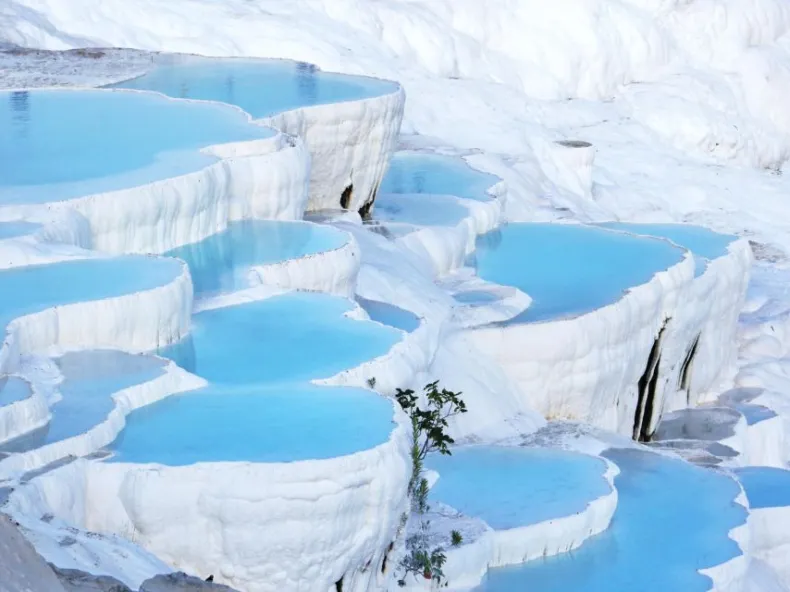
June is the last easy month at Pamukkale, and "easy" is doing some work in that sentence. The heat has arrived, but it is still the kind you plan around rather than fight. The days are the longest of the year, so the white hill stands in full light from the first stop of the programme to the last. And the coaches are fuller than in May without yet carrying the whole weight of the school-holiday season. June is the month where summer discipline starts to matter — and the last month where that discipline, on its own, is enough.
Fuller than May, a long way from August
Nothing about the hillside changes on the first of the month. What changes is the arithmetic of who is standing on it. Term time in most of the countries our guests fly from still runs through the first half of June, and in Germany the summer break lands in different weeks in different states, so the season builds instead of breaking. An early-June day at the site feels like a busy spring day. A late-June day already has the shape of high season in it.
In practice that means the most photographed stretch of terrace gathers a crowd while the rest of the site does not — which is precisely what August takes away from you. Hierapolis in June still has empty corners in it. If crowd levels are deciding your dates, our guide to when Pamukkale is quiet separates the yearly rhythm from the one that plays out inside a single day.
Heat you can plan around
Your hotel sits on the Mediterranean. Pamukkale does not. The coach crosses the Taurus mountains onto an inland plateau in Denizli province, and that plateau runs drier, stiller and harder through the middle of the day than the coast ever does. June is when the gap between the two opens up for the first time in the season, which catches out visitors who read a coastal forecast and packed for it.
The answer is not complicated, and it is not optional either: a brimmed hat rather than a cap, sunglasses, high-SPF sunscreen before you leave the coach and again during the visit, and water you genuinely drink instead of carry. Inland heat is dry, so it takes more out of you than the humid coast while feeling like less. Keep some cash for cold bottles too — drinks are not included, at meals or anywhere else. Everything else worth packing is on our day-trip packing list, which is worth five minutes the night before.
The part nobody warns you about: hot stone underfoot
Shoes come off on the designated open section of the travertine terraces. That is a site rule rather than a tradition, and it is what keeps the calcite white. In April it is a pleasant novelty. By the middle of a June day the dry ridges between the pools have been sitting under a high sun for hours, and they are hot on bare feet.
Walk them the way the regulars do: stay in the shallow thermal water wherever the route allows, cross the dry stretches without dawdling, and let the next pool cool your feet again. Wet feet, damp wrists and a splash on the back of the neck do more for you in June than any shade break. Keep the distinction straight while you are at it — those pools are for wading, not swimming. A real swim happens in exactly one place, the optional Cleopatra Pool above the terraces, with its submerged marble columns and its own ticket bought on site.
Hierapolis is where June gets tested
The terraces are half the day. Above them stands Hierapolis, the Greco-Roman spa city that grew around these springs: the theatre cut into the hillside, the vast necropolis, Frontinus Street and its monumental gates. It is an archaeological site, which means the shade is whatever a wall or a gateway happens to throw. No avenue of trees is waiting for you at the top.
So the hat is the roof you brought with you, you drink before you are thirsty, and the air-conditioned coach does the job it is there for between chapters of the visit. Lunch at a local restaurant near the site takes the hottest stretch of the day off your hands, in the shade, with a chair under you. The thing to ration in June is ambition: trying to walk every corner of Hierapolis at pace is how people end the day flattened.
The longest usable daylight of the year
Here is June's quiet advantage. The trip is long by design — roughly 11–14 hours door to door, depending which of the 30 pickup areas between Tekirova and Gazipaşa you set out from — and in most months a good share of the drive home happens in the dark. June hands you the longest daylight of the year, so the mountains stay in the window far longer on the return leg, with dinner served on board while you can still see the country you are crossing. Photographers get the same gift at the site: the light lasts, and the white hill keeps changing colour while it does.
Who June suits, and who should pick another month
June is a good fit if you want the coast in full swing but the site not yet at its busiest, if you can travel before a school calendar takes over your summer, and if you are the kind of traveller who reads a packing list and then actually follows it.
Choose May instead if heat is a real problem for you, if grandparents are coming, or if you want the shortest possible list of things to manage on the day — our May guide makes that case and shows how the tour fits into a short trip. Choose September if you want warmth without the peak and can wait for the school-holiday wave to drain away; the September guide explains why that month is the easiest of the year here. And if July or August is already fixed by your flights, the summer heat playbook was written for exactly that situation.
What June does not change
Departures run daily from March to November, so a June date is a matter of choosing rather than chasing. Pickup is early in the morning from your hotel, and the exact time for your hotel arrives with your booking confirmation, because it genuinely differs from resort to resort. The price is €50 per person, flat, from every pickup area, for everyone aged 4 and over, with infants 0–3 travelling free — no child rate and no stripped-down version. That covers hotel pickup and drop-off, the air-conditioned coach, a licensed guide, travel insurance and three meals: breakfast on the morning drive, lunch near Pamukkale, dinner on the way home.
Entrance tickets stay outside the price on purpose. Official gate prices are set by the site administration and move with the season, so you pay the true amount at the ticket office rather than a padded guess buried in ours; the full reasoning sits on our page about how entrance fees work. The programme itself can shift with season and operating conditions: a stop at the red springs of Karahayıt or at Lake Salda is a bonus when it happens, never a promise.
Reserve free online and pay on the day of the tour, with free cancellation up to 24 hours before departure — pick your June date here, or message us on WhatsApp at +90 536 603 75 84 if your hotel is off the standard list or your dates are tight. Still weighing the months against each other? The best time to visit Pamukkale puts all four seasons side by side without wishful thinking.