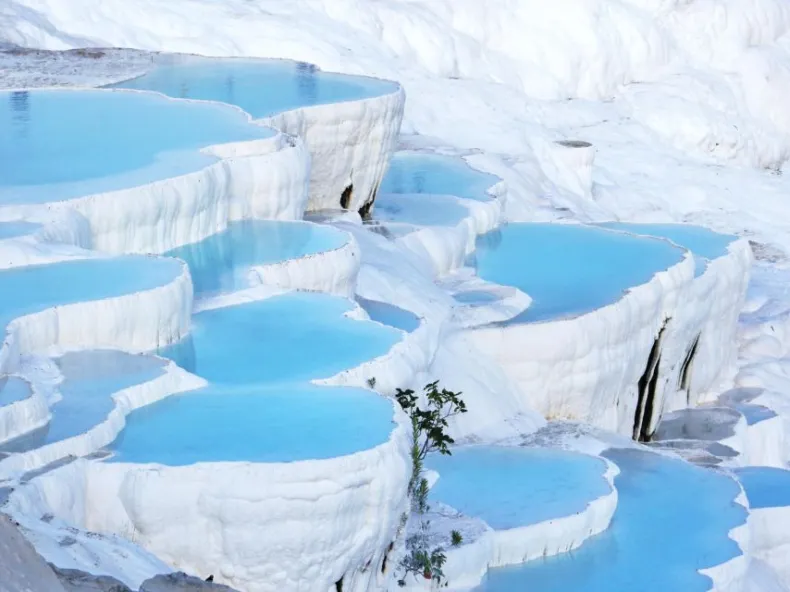
Short answer: yes, and since 1988. The place appears on the UNESCO World Heritage List under the name Hierapolis-Pamukkale, reference 485 — but the detail worth carrying up the hill with you is not the year. It is the category. The site was inscribed as a mixed property, under criteria (iii), (iv) and (vii). All of that sits in UNESCO's own entry for the site at whc.unesco.org/en/list/485. What follows is what those brackets mean, and why they turn out to explain almost every rule you will meet at the gate.
What a "mixed" World Heritage Site actually is
UNESCO measures a candidate against ten criteria. The first six are cultural — human work, human history, human ideas. The last four are natural — geology, ecosystems, natural beauty. A place can be listed for its cultural value, for its natural value, or, when it earns both at once, as a mixed property. Hierapolis-Pamukkale sits in that third group.
Its three criteria split neatly along that seam. Criterion (vii) is the natural one: superlative natural phenomena, or areas of exceptional natural beauty. Criteria (iii) and (iv) are cultural: exceptional testimony to a civilisation, and an outstanding example of an ensemble that illustrates a significant stage in human history. Two separate verdicts, one hillside — and the same warm water responsible for both of them.
That is why the site has one name with a hyphen in it. Pamukkale and Hierapolis are not two attractions that happen to share a car park. UNESCO treated them as a single property because they are a single story: the springs made the terraces, the terraces made the springs famous, and the fame built a city.
The natural half: a hillside still being built
The white terraces are calcite, left behind by thermal water that has run down this slope for thousands of years. The water surfaces hot and loaded with dissolved mineral; the moment it hits open air it starts cooling and shedding carbon dioxide, and it can no longer hold that mineral, so it lays it down as a film of stone on everything it touches. Rims build faster than floors, so every shallow puddle grows an edge, and the edge holds deeper water, which grows its own edge. Repeat for a few thousand years and you get the staircase of scalloped white bowls you came to photograph.
Criterion (vii) is doing simple work here: this is a natural phenomenon of a kind you will not find on the rest of your holiday. It is also unfinished. The deposit is still being laid while you stand in it, which is exactly why a listing that protects it has to protect a process rather than an object. Our page on the travertine terraces follows the geology further, and if you have seen forum arguments about whether any of it is real, the natural-or-man-made question is settled in the same place the listing settles it.
The cultural half: the city that grew on top
Above the terraces stands Hierapolis, the Greco-Roman spa city founded around these springs and built up as a healing centre under Hellenistic and then Roman rule. People travelled here to bathe, to drink the water and to be cured by it, and the town that served them grew rich enough to build accordingly: a grand Roman theatre carved into the hillside, colonnaded Frontinus Street with its monumental gates, temple and church remains marking the long religious afterlife, and a vast necropolis — one of the best-preserved ancient cemeteries in Anatolia — lining the roads out of town.
Criterion (iii) rewards exceptional testimony to a civilisation, and a whole city organised around a hot spring is testimony of an unusually clear kind: you can read an entire ancient idea of health off the street plan. Criterion (iv) rewards the ensemble itself — theatre, streets, gates, baths and tombs surviving together as an example of what a Roman spa city was. Walk it with a licensed guide and the two criteria stop being paperwork; see Hierapolis and its short history for the tour of the stones.
Why the listing is the reason for the rules
This is where an abstract designation becomes something you feel on the day. Young calcite is soft. Hard soles grind it, scuff it grey and leave marks that do not buff out, so the site takes your shoes off you before it lets you onto the open section — the barefoot rule is conservation, not folklore, and we explain it properly here. The pools you wade in are shallow: this is wading, not swimming. Swimming happens in one place only, the Cleopatra Pool, which has its own separate ticket bought on site.
The ropes and fences follow the same logic. Only a designated section of the hillside is open for walking at any time, and the spring flow is steered towards it while other terraces rest, harden and go bright white again undisturbed. A dry terrace is not a broken one; it is a terrace off duty. And because this is a protected site rather than a private attraction, the entrance ticket belongs to the site administration, not to a tour operator — you pay the official price at the gate, which is why our entrance-fee page refuses to quote you a padded estimate.
Seeing a World Heritage Site in a day
From the Antalya coast the whole thing works as one long, well-fed day out. The Pamukkale tour from Antalya is a flat €50 per person for everyone aged 4+, with infants 0–3 free, covering hotel pickup and drop-off, an air-conditioned coach, a licensed guide, travel insurance and three meals. Reckon on roughly 11–14 hours door to door depending on where you are staying, with an early-morning pickup whose exact time is confirmed with your booking. Entrance tickets are paid at the gate; the programme can shift with the season, so an operational stop such as Karahayıt or Lake Salda may be added or dropped.
Two criteria for the ruins, one for the hillside, one hyphenated name on a list drawn up in 1988. Stand at the top tier of the theatre with the white terraces spilling away below you and the arithmetic makes itself obvious. For how the rest of the day fits together, the complete guide walks through it chapter by chapter.