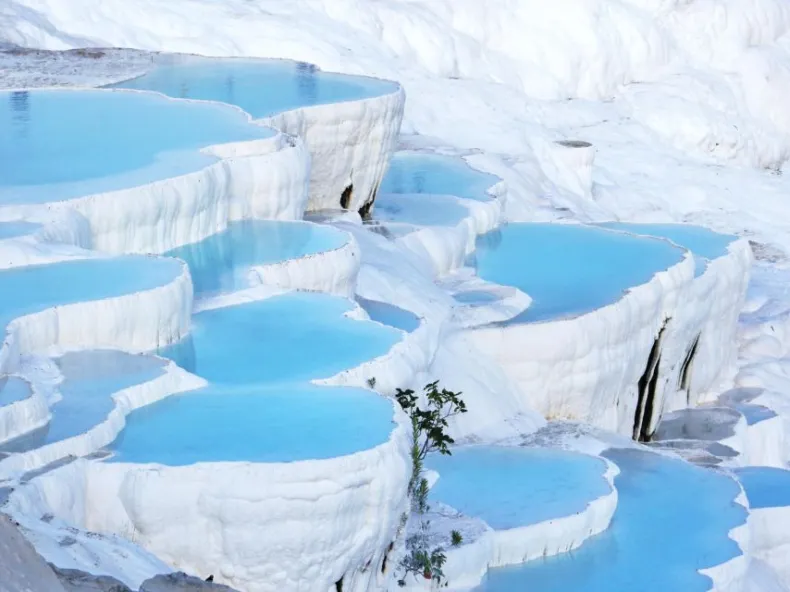
Nearly everything worth doing at Pamukkale sits on one hillside, and that is the most useful thing to know before you arrive. The white terraces are at the bottom. The ruined spa city of Hierapolis spreads across the plateau above them. UNESCO listed the two together in 1988 as a single mixed World Heritage Site, and on the ground they really are one place — you step out of the calcite pools and into a Roman street. So the question is never which of them to see. It is how much of the plateau you cover before your legs give up, and which of the separately ticketed extras you decide to pay for.
Down at the bottom: the travertine terraces
This is the postcard, and it is the part of the day nobody regrets. Thermal water saturated with dissolved limestone has been spilling down this slope for millennia and shedding its mineral load as it cools, building the hillside out of hard white calcite, shelf after shelf. Visitors are let into one designated open section, and they go through it with their shoes off — a site rule that protects the surface, and the reason everyone at Pamukkale is carrying their sandals. The pools are shallow, so this is wading rather than a swim. Give the terraces unhurried time; they are also where the light does half the work for your photographs.
Up on the plateau: Hierapolis, monument by monument
Above the terraces the ground levels out and the ancient city begins. Hierapolis began as a Hellenistic foundation of the Pergamene kings and made its fortune under Rome on a single asset: hot water. The ill travelled a long way for it, trusting that the springs would do what their doctors had not. A great deal survives, but it is spread out, so it pays to know what each piece is before you decide where to spend your feet.
- The Roman theatre — the best-preserved thing on the hill and the one monument that repays a climb without argument. It was cut into the slope rather than raised on flat ground, the seating still sweeps up in a great stone bowl, and the decorated stage building stands facing it. It sits high, so this is the uphill part of the day. More on the theatre.
- Frontinus Street and the monumental gates — the city's main artery, driving dead straight through the ruins with the open ground of the agora beside it, entered through an arched gate flanked by round towers and named after a Roman governor of the province. Flat, already on your line of walk, and the moment the town plan suddenly makes sense. More on the gate and the street.
- The necropolis — an ancient cemetery the size of a suburb, lining the old northern road with burial mounds, carved stone chests and little tomb houses complete with doors and gables. One of the best-preserved in Anatolia, and a strange neighbour for a city that lived off healing. You do not need to walk the whole length of it. More on the necropolis.
- The Ploutonion, Pluto's Gate — a cave mouth beside the temple of Apollo that still releases volcanic carbon dioxide from below. The ancients read it as a doorway to the underworld and built a sanctuary around it. Today it is looked at from the visitor path and never entered: a two-minute stop with a very long story. More on Pluto's Gate.
- The Hierapolis Archaeology Museum — housed in the restored halls of a Roman bath building, so the architecture is the first exhibit. Inside are the sarcophagi, statues and reliefs that cannot be left out in the weather. It keeps its own ticket at its own door, and it is indoors — the obvious move when the sky turns, the obvious cut on a hot, short afternoon. More on the museum.
The Cleopatra Pool: where you actually get in the water
In the middle of the ruins, a short walk above the calcite, the Cleopatra Antique Pool holds warm spring water over a floor of fallen marble — column drums and carved blocks that an earthquake dropped in antiquity and nobody ever hauled out. Swimming here is the only swimming at Pamukkale, and it is entirely optional: the pool sells its own separate ticket at the door, you need a swimsuit and towel with you, and changing and drying eat a real slice of the free time the ruins also want. A wonderful memory if warm water over Roman marble is your idea of one, and easy to skip if it is not.
What people skip when the clock runs out
Honestly, the museum and the pool go first, because each costs a separate ticket and a genuine block of time. The necropolis is next: most visitors look at the tombs nearest the road, take the point and turn back rather than marching the full length. Almost nobody skips the terraces, and almost nobody who has come this far skips the theatre. Frontinus Street and the Ploutonion survive every version of the plan because they lie on the line you are already walking. If you want that ranking argued out properly, our priority order for Hierapolis in one visit does exactly that, and how long you need at Pamukkale sets time against it.
One practical note sits under all of it: the site entrance, the museum and the pool are three separate official counters, each paid at its own gate. Entrance tickets are deliberately kept out of the tour price, because the administration moves those tariffs with the season — we would rather sell you the day and let you pay the real amount than bury a padded estimate in it. How the entrance fees work explains the whole arrangement.
The two stops nobody should promise you
Karahayıt, roughly 5 km north, is where the thermal water runs red instead of white: iron-rich springs staining the rock rust and brick, the colour negative of the terraces down the road. Lake Salda, much further out in Burdur province near Yeşilova, is a deep freshwater lake ringed with startlingly white mineral shores. Both appear on some routings of our day and not on others: they are seasonal operational stops, added or removed with the season and the conditions, and never guaranteed. Take either as a bonus when the programme allows it, never as the reason you booked.
All of that fits inside one long day from the coast. The full-day Pamukkale tour from Antalya is a flat €50 per person for everyone aged 4 and over, with infants 0–3 free, and includes hotel pickup, a licensed guide, insurance and three meals; door to door it runs roughly 11–14 hours depending on your resort. Reserve online for free and pay on the day — and if you want the trip explained end to end first, start with the complete guide.