Most people about to book this trip are not looking for a timetable. They want to know what the day is like: whether it is worth losing a lie-in for, how much of it is spent sitting down, and whether they will be the one lagging behind the group. So here is the day as guests actually live it — the early alarm, the long drive, the hillside that stops conversation, and the very quiet coach coming home. If you want the stages listed in order instead, the complete guide to the tour does that job.
The early start you will still feel tomorrow
It begins with an alarm set earlier than any holiday alarm should be. Pickup is early morning from your hotel, and the exact time reaches you with your booking rather than being printed on a page — the route is the reason, since one departure collects from thirty pickup areas strung between Tekirova and Gazipaşa and is rebuilt around whoever is travelling on your date. Breakfast is not your problem: it is served during the morning drive, so nothing depends on the hotel kitchen being awake.
The first stretch is the sleepiest part of the day. The vehicle is air-conditioned, it fills up gradually as it works along the coast, and your licensed guide says hello and then, sensibly, lets everybody doze. Nobody is chatty. Half the group is asleep within minutes of sitting down, and that is exactly how it should go — the early start is what buys you a proper stretch of daylight at the far end.
A long drive, broken on purpose
Pamukkale is not on the coast. The terraces hang above the town of the same name in Denizli province, well inland, so every route from the Antalya shore has to climb the Taurus mountains: pine slopes, passes, then high plateau farmland before the road drops into the Denizli plain. It is a proper intercity drive rather than a resort transfer, and the winding section is the part that matters if anyone in your party travels badly.
The day is deliberately cut into pieces so it never becomes one unbroken slog. Breakfast on the move, rest stops along the way, a sit-down lunch at a local restaurant in the Pamukkale area, dinner served on the return. Drinks are not included with any of them, at meals or anywhere else. The programme can also shift with the season and operating conditions: a stop at the red thermal springs of Karahayıt or at white-shored Lake Salda is sometimes added and sometimes not, so treat either as a bonus rather than a promise.
The moment the white hillside appears
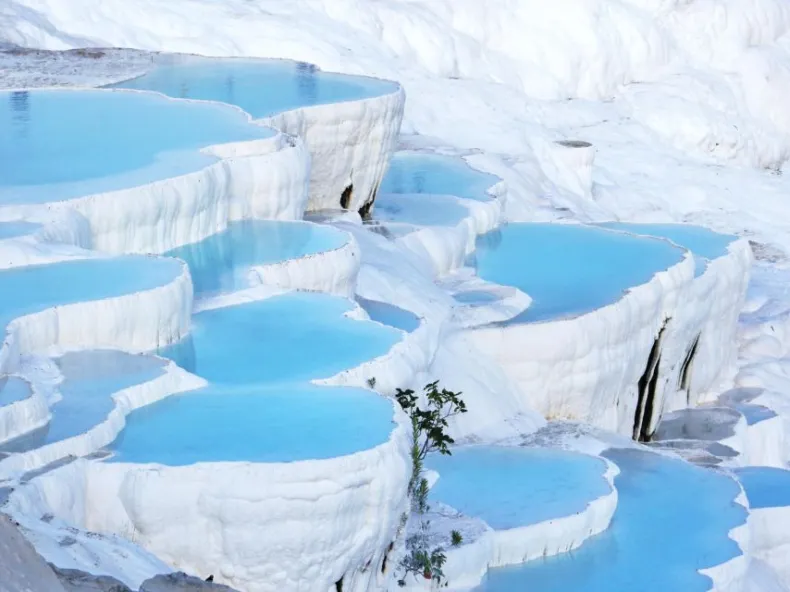
You usually see it before anyone announces it. The valley opens out and there is a wide white spill down a green hillside that your brain files as snow for a second before it corrects itself. That is calcite: mineral-rich thermal water has run down that slope for millennia and left the white behind, which is what the name cotton castle is about — the travertines page explains what you are looking at. Phones come out. The coach gets loud again for the first time since the coast.
Shoes off at the entrance
At the terrace entrance everyone stops and takes their shoes off. It is a site rule rather than a quirk: bare feet protect the calcite surface, and that one rule is a large part of why the white is still white. You carry your shoes or hang them off your bag, roll your trousers, and walk the designated open section.
Underfoot it is stranger and kinder than the photographs suggest. The water is warm and shallow — you walk through it, not into it — and the surface is ridged and chalky rather than polished glass. Some stretches are dry and rough on the soles. The honest advice is to go slowly and plant each foot; nobody looks graceful doing this, and the people who hurry are the people who slip. This is wading, and only wading: the one place you actually swim is the Cleopatra Pool.
Hierapolis with the guide, then the day is yours
Above the terraces stands Hierapolis, the Greco-Roman spa city built around these hot springs. The two are a single UNESCO World Heritage Site, inscribed in 1988, and they sit shoulder to shoulder, so no transfer eats into your time. This is the guided heart of the day: your guide walks the group through the grand hillside-carved Roman theatre, along Frontinus Street and its monumental gates, past temple and church remains and out to the vast necropolis — one of the best-preserved ancient cemeteries in Anatolia — turning a field of stones back into a working city.
Then the guiding stops and the free time starts, which is the part most people quietly want to know about. Some walk back down for the terrace photographs they were too busy to take the first time. Some go deeper into the ruins. Some spend it swimming above submerged ancient marble columns in the Cleopatra Antique Pool, which is optional and has its own separate ticket bought on site. Your guide sets a meeting point and then leaves you alone — nobody is herded, and nobody counts your photographs.
The parts that are genuinely hard
Length first. Door to door the day runs roughly 11–14 hours depending on how far east your resort sits, and a large share of that is riding. If coaches are not your thing, good scenery does not cancel that out.
Heat second. In high summer the white slope is open ground with nothing above it, and pale stone throws the light straight back at you; the summer page is blunt about how to handle that. Water, a hat, sunglasses, and no attempt to see everything at a march.
Ground third. Hierapolis is ancient and uneven — broken paving, loose stone, slopes and steps, spread over a large area. None of it is technical, but it accumulates, and how much walking there really is is worth reading if knees, hips or a pushchair are part of your calculation.
And one expectation to reset before you travel: the terraces are not a swimming pool with a view. Warm shallow water over your feet on a world-famous hillside is the experience. The visitors who arrive picturing lengths in deep turquoise basins are the ones who come away disappointed, and that is a photo-editing problem rather than a Pamukkale problem.
The quiet drive home
Dinner is served on the return journey, and after it the coach goes properly silent. Sun-tired, footsore, camera roll full, half the group asleep against the window — that is the standard picture of the way back, and it is a good sign rather than a bad one. You are dropped at your hotel, and you feel the day in your legs the next morning, which is why a beach day afterwards beats another excursion; where to slot the trip into your holiday works through the timing.
What you pay on the day stays simple: €50 per person for everyone aged 4 and over, infants 0–3 free, plus the official entrance tickets at the gates, the optional pool ticket if you want it, and your drinks. Tickets are bought at the gate at the real official price instead of being padded into ours, and the on-the-day costs page lists the lot. Reserving costs nothing up front: you can book the Pamukkale tour online and pay on the day, cancel free up to 24 hours before departure, and the tour runs daily from March to November and Monday to Saturday through the winter.